

No products
Garlic seeds
-
Semi ortaggi
-
Summer vegetables seeds
- Garlic seeds
- Watermelon seeds
- Asparagus seeds
- Chili seeds
- Beet seeds
- Basil seeds
- Chard seeds
- Cabbage seeds
- Onion seeds
- Carrot seeds
- artichoke seeds
- Cucumber seeds
- Strawberry seeds
- Bean and green bean seeds
- Broad bean seeds
- Lettuce seeds
- Corn seed
- Eggplant seeds
- Melon seeds
- Okra seeds
- Tomato seeds
- Pea seeds
- Leek seeds
- Pepper seeds
- Radish seeds
- Arugula seeds
- Shallot seeds
- Celery seeds
- Spinach seeds
- Valerian seeds
- Pumpkin seeds
- Courgette seeds
-
Winter vegetables seeds
- broccoli seeds
- cauliflower seeds
- semi di cavolo
- fennel seeds
- Semi di lattuga
- chicory seeds
- Radicchio seeds
- Rocket seeds
- Chard and Beet Seeds
- Escarole Seeds
- Onion Seeds
- Basil Seeds
- Chard Seeds
- Artichoke Seeds
- Carrot Seeds
- Cucumber Seeds
- Bean Seeds
- Endive Seeds
- Leek Seeds
- Parsley Seeds
- Celery Seeds
- Spinach Seeds
- Valerian Seeds
-
Summer vegetables seeds
- Peperoncino secco
- Peperoncino in polvere
- Semi piante aromatiche
- Prati e tappeti erbosi
- Semi fiori ornamentali
- Fertilizzanti
- Fertilizzante solido
- Spezie
- eBook
- Bulbi
- Starter kit / Micro orto
- Idea regalo / Bomboniere
- Patate e tuberi da semina
- Buoni regalo digitali
- TEST posizioni
 View larger

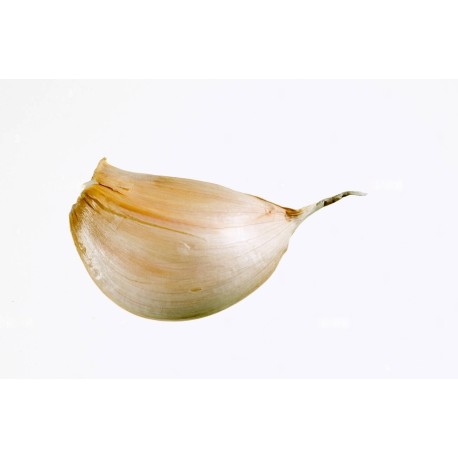
Valdichiana Elephant Garlic Clove
New product
Clove or bulbil of Valdichiana elephant garlic, ready to be planted
500 Items
More info
- Valdichiana elephant garlic clove
- The Valdichiana elephant garlic plant
- How to plant Valdichiana elephant garlic
- How to grow Valdichiana elephant garlic
- Tips for growing Valdichiana elephant garlic
- Diseases and pests of Valdichiana elephant garlic
- Properties of Valdichiana elephant garlic
- Nutritional values of Valdichiana elephant garlic (per 100 g)
Valdichiana elephant garlic clove
As mentioned, this clove (or bulbil) of Valdichiana elephant garlic is ready to be planted straight into the garden. Elephant garlic, botanically known as Allium ampeloprasum var. holmense, is an ancient and fascinating vegetable, deeply tied to the Tuscan territory of the Val di Chiana, between the provinces of Arezzo, Siena and Perugia. It should not be confused with common garlic (Allium sativum): it is in fact a distinct botanical species, more closely related to the leek, which is why it is called elephant garlic in English, due to the truly generous size of its bulb.
The Valdichiana elephant garlic plant
Botanically it belongs to the Allium ampeloprasum group, the same as the leek, which is why its flavour is much milder and less pungent than traditional garlic, with better digestibility also due to the near absence of alliin in its tissues. The bulb, ivory-white in colour, can reach surprising sizes, sometimes up to 800 grams, and is made up of a small number of very large cloves, generally five or six, arranged in a crown around the stem.
It is a perennial geophyte, grown as an annual in the home garden: it spends the unfavourable season as an underground bulb, ready to resume growth once conditions improve. It is a historic product, included among Tuscany's Traditional Agri-Food Products (P.A.T.), famous above all for pici all'aglione, a classic dish of Valdichiana cuisine.
How to plant Valdichiana elephant garlic
Cloves are traditionally planted between October and November, selecting the largest, firmest outer cloves, free from mould, separated from the bulb shortly before planting. They should be buried with the tip facing upward and the base downward, at a depth of 5-6 centimeters. Propagation happens exclusively through vegetative means using the cloves, since elephant garlic does not produce fertile seed under normal growing conditions.
How to grow Valdichiana elephant garlic
It prefers loose, sandy, well-drained soil with a neutral pH, generally between 6 and 7, rich in organic matter and with low salinity. A sunny position supports optimal bulb development. Light mulching with straw or fine wood chips, about 2-3 centimeters thick, helps retain soil moisture and keep weeds under control.
The plant tolerates cold well, although it prefers a temperate climate, and follows a growing cycle similar to that of common garlic. Harvest typically happens in summer, once the above-ground part starts to dry out, following the same timing and signs as traditional garden garlic.
Tips for growing Valdichiana elephant garlic
Given the generous size of the bulbs and cloves, it is important to provide adequate spacing between plants to allow full development of the underground bulb. Soil that is too compact or clay-heavy should be avoided or amended with sand and organic matter, as elephant garlic prefers loose, well-aerated soils to grow without obstacles.
Diseases and pests of Valdichiana elephant garlic
Like other members of the Allium genus, elephant garlic can be prone to root rot in cases of prolonged waterlogging, so good soil drainage remains the best form of prevention. It can occasionally be attacked by thrips or soil nematodes: regular crop rotation, avoiding replanting in the same spot for several consecutive seasons, helps keep the crop healthy.
Properties of Valdichiana elephant garlic
Thanks to the reduced presence of alliin and its sulfur derivatives, elephant garlic is much more digestible than common garlic, while still retaining a pleasant, distinctive aroma. It is traditionally valued in the kitchen for flavouring dishes without being overpowering, and is considered a niche product currently undergoing strong growth, rediscovered today by local farms committed to preserving its traditional cultivation in the Valdichiana.
Nutritional values of Valdichiana elephant garlic (per 100 g)
- Calories: 134 kcal
- Protein: 5.1 g
- Fat: 0.3 g
- Carbohydrates: 28 g
- Fiber: 2.3 g
- Vitamin C: 17 mg
- Potassium: 370 mg