

No products
Pepper seeds
-
Semi ortaggi
-
Summer vegetables seeds
- Garlic seeds
- Watermelon seeds
- Asparagus seeds
- Chili seeds
- Beet seeds
- Basil seeds
- Chard seeds
- Cabbage seeds
- Onion seeds
- Carrot seeds
- artichoke seeds
- Cucumber seeds
- Strawberry seeds
- Bean and green bean seeds
- Broad bean seeds
- Lettuce seeds
- Corn seed
- Eggplant seeds
- Melon seeds
- Okra seeds
- Tomato seeds
- Pea seeds
- Leek seeds
- Pepper seeds
- Radish seeds
- Arugula seeds
- Shallot seeds
- Celery seeds
- Spinach seeds
- Valerian seeds
- Pumpkin seeds
- Courgette seeds
-
Winter vegetables seeds
- broccoli seeds
- cauliflower seeds
- semi di cavolo
- fennel seeds
- Semi di lattuga
- chicory seeds
- Radicchio seeds
- Rocket seeds
- Chard and Beet Seeds
- Escarole Seeds
- Onion Seeds
- Basil Seeds
- Chard Seeds
- Artichoke Seeds
- Carrot Seeds
- Cucumber Seeds
- Bean Seeds
- Endive Seeds
- Leek Seeds
- Parsley Seeds
- Celery Seeds
- Spinach Seeds
- Valerian Seeds
-
Summer vegetables seeds
- Peperoncino secco
- Peperoncino in polvere
- Semi piante aromatiche
- Prati e tappeti erbosi
- Semi fiori ornamentali
- Fertilizzanti
- Fertilizzante solido
- Spezie
- eBook
- Bulbi
- Starter kit / Micro orto
- Idea regalo / Bomboniere
- Patate e tuberi da semina
- Buoni regalo digitali
- TEST posizioni
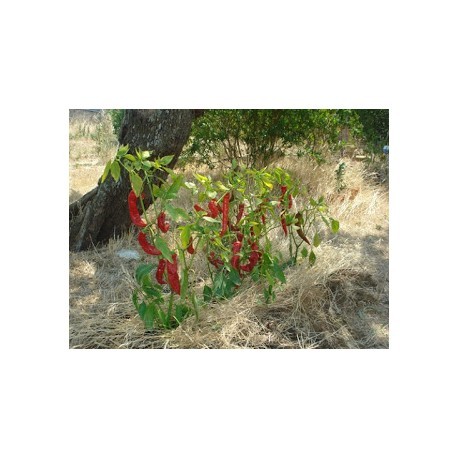 View larger

Goat Horn Pepper Seeds
New product
Seeds of an old sweet pepper variety from southern Italy, thin and curved like a goat's horn, prized for drying.
100 Items
More info
- goat horn pepper
- The goat horn pepper plant
- How to sow the goat horn pepper
- How to grow the goat horn pepper
- Tips for growing the goat horn pepper
- Diseases and pests of the goat horn pepper
- Properties of the goat horn pepper
- Nutritional values of the goat horn pepper (per 100 g)
goat horn pepper
The goat horn pepper is an old and much-loved variety from southern Italy, grown mainly in Basilicata, Campania, Calabria and parts of Puglia. It takes its name from the thin, curved, pointed shape of the fruit, which resembles a goat's horn. It is a sweet, never spicy pepper, bright red when ripe, prized for its thin flesh and remarkable suitability for drying.
The goat horn pepper plant
It belongs to the species Capsicum annuum, with an upright, vigorous and well-branched habit, capable of sustaining an abundant fruit set per plant. The leaves are deep green, medium-sized, and offer some protection to the developing fruit.
The fruit is elongated, thin and curved, reaching a length of 20-23 cm and a diameter of just 4-5 cm, tapering to a pointed tip. The skin is smooth and thin, the flesh fine and almost free of water, a trait that makes it ideal for hanging and air-drying, following the traditional farming practice of southern Italy.
How to sow the goat horn pepper
Sow in a protected seedbed between February and March, keeping a steady temperature of 20-25°C to encourage even germination, which usually occurs within 10-15 days. Transplant into open field from April to May, once the risk of late frost has passed, spacing seedlings about 40-50 cm apart along the row and 70-80 cm between rows.
How to grow the goat horn pepper
This variety favors loose, fertile, well-draining soil rich in organic matter, with full sun exposure throughout the growing cycle. The ideal pH is slightly acidic to neutral; it's good practice to work well-rotted manure or compost into the soil before transplanting, to give the plant the nutrient reserves it needs for abundant fruiting.
Watering should stay regular but never waterlogged, increasing frequency during the hottest months and while fruit is setting. Light pinching of young plants encourages a more compact habit and better branching, while staggered harvesting, once fruits are firm and fully red, stimulates the plant to keep producing.
Tips for growing the goat horn pepper
As a fairly rustic plant used to soils with limited water, it's best not to overdo watering or nitrogen feeding, which would favor excessive leaf growth at the expense of fruiting. Container growing is possible with pots of at least 25-30 cm in diameter, though the plant performs best in open field, where it can develop freely.
Diseases and pests of the goat horn pepper
Powdery and downy mildew are the main threats, favored by excess humidity and poor airflow between plants, best prevented with correct plant spacing and targeted treatments during critical periods. Aphids and spider mites are the most common pests, kept in check with regular foliage checks and, if needed, treatments based on potassium soap or neem oil.
Properties of the goat horn pepper
Thanks to its thin, low-water flesh, this pepper is particularly well suited to drying, a preservation method that concentrates its sweet, lightly smoky flavor, much appreciated in traditional southern Italian cooking, in dishes such as the famous crispy dried peppers or as a base for homemade sweet paprika. It is also a natural source of vitamin C and antioxidants, with a low calorie content that fits well into a balanced diet.
Nutritional values of the goat horn pepper (per 100 g)
- Calories: 31 kcal
- Protein: 1 g
- Fat: 0.3 g
- Carbohydrates: 6 g
- Fiber: 2 g
- Vitamin C: 120 mg
- Potassium: 211 mg