

No products
Watermelon seeds
-
Semi ortaggi
-
Summer vegetables seeds
- Garlic seeds
- Watermelon seeds
- Asparagus seeds
- Chili seeds
- Beet seeds
- Basil seeds
- Chard seeds
- Cabbage seeds
- Onion seeds
- Carrot seeds
- artichoke seeds
- Cucumber seeds
- Strawberry seeds
- Bean and green bean seeds
- Broad bean seeds
- Lettuce seeds
- Corn seed
- Eggplant seeds
- Melon seeds
- Okra seeds
- Tomato seeds
- Pea seeds
- Leek seeds
- Pepper seeds
- Radish seeds
- Arugula seeds
- Shallot seeds
- Celery seeds
- Spinach seeds
- Valerian seeds
- Pumpkin seeds
- Courgette seeds
-
Winter vegetables seeds
- broccoli seeds
- cauliflower seeds
- semi di cavolo
- fennel seeds
- Semi di lattuga
- chicory seeds
- Radicchio seeds
- Rocket seeds
- Chard and Beet Seeds
- Escarole Seeds
- Onion Seeds
- Basil Seeds
- Chard Seeds
- Artichoke Seeds
- Carrot Seeds
- Cucumber Seeds
- Bean Seeds
- Endive Seeds
- Leek Seeds
- Parsley Seeds
- Celery Seeds
- Spinach Seeds
- Valerian Seeds
-
Summer vegetables seeds
- Peperoncino secco
- Peperoncino in polvere
- Semi piante aromatiche
- Prati e tappeti erbosi
- Semi fiori ornamentali
- Fertilizzanti
- Fertilizzante solido
- Spezie
- eBook
- Bulbi
- Starter kit / Micro orto
- Idea regalo / Bomboniere
- Patate e tuberi da semina
- Buoni regalo digitali
- TEST posizioni
 View larger
Round Black Watermelon Seeds
New product
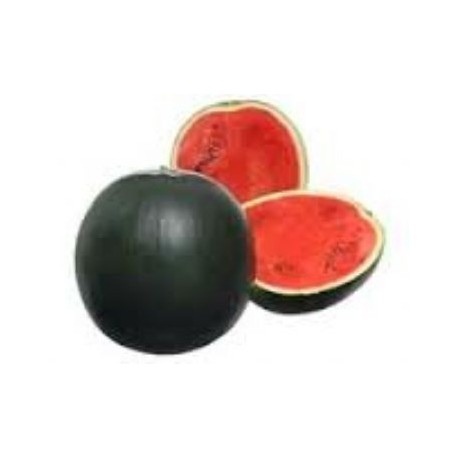
Seeds of a variety typical of southern Italy, with intensely red, very sweet flesh and a dark green rind that turns almost black.
97 Items
More info
- round black watermelon
- The round black watermelon plant
- How to sow round black watermelon
- How to grow round black watermelon
- Tips for growing round black watermelon
- Diseases and pests of round black watermelon
- Properties of round black watermelon
- Nutritional values of round black watermelon (per 100 g)
round black watermelon
The round black watermelon is a variety typical of southern Italy's traditional cultivation, prized for generations for its intensely red, very sweet and juicy flesh, enclosed in a dark green rind that turns almost black. It's a favorite for anyone seeking the authentic flavor of traditional watermelon, grown according to time-honored methods.
The round black watermelon plant
This is a cucurbit (Citrullus lanatus) with a trailing, vine-like habit, long vigorous stems and abundant foliage that shields the developing fruit from direct sun. The plant favors a long summer growing cycle, typical of warm southern regions, with steady productivity over time.
The fruit has a regular round shape and medium-large size. The rind is very dark green, almost black, uniform across the whole surface, while the flesh inside is bright red, firm and full of juice, with a strong, sweet flavor much appreciated.
How to sow round black watermelon
Sowing should take place in open field from April to May, once soil temperature has stabilized at least 18-20°C, or in a protected seedbed from March for earlier transplanting. Seeds should be buried 2-3 cm deep, spaced 90-100 cm apart along the row, with rows 150-200 cm apart given the plant's notable vigor. Germination usually occurs within 7-10 days at temperatures between 22 and 28°C.
How to grow round black watermelon
This variety thrives in the warm, sunny climates typical of southern Italy, with optimal temperatures between 24 and 32°C. The ideal soil is deep, well-draining and rich in organic matter, worked deeply before transplanting to support root development. The growing cycle is fairly long, but rewards with large fruit and intense flavor.
Watering should be kept regular during vegetative growth and fruit swelling, then gradually reduced as ripening approaches to concentrate sugars in the flesh. It's good practice to rotate the crop every 3-4 years to prevent buildup of soil-borne cucurbit pathogens.
Tips for growing round black watermelon
Placing a straw base or support under each developing fruit prevents direct contact with damp soil, reducing the risk of blossom-end rot. Given the plant's vigor, it's useful to periodically thin out excess fruit to encourage more uniform sizes and even ripening across the whole plant.
Diseases and pests of round black watermelon
Like all cucurbits, this variety can be susceptible to powdery and downy mildew during humid periods, best managed with good airflow between plants and targeted preventive treatments. Common pests include aphids and spider mites, manageable with regular checks and treatments based on potassium soap or neem oil when needed.
Properties of round black watermelon
The deep red flesh of this watermelon is mostly water, making it extremely hydrating and refreshing, ideal for the hot days typical of a southern summer. It's naturally low in calories and easy to digest, while providing simple sugars that account for its sweet taste and immediate energy boost. It also contains lycopene, a powerful antioxidant, along with a good supply of potassium and vitamin C.
Nutritional values of round black watermelon (per 100 g)
- Calories: 30 kcal
- Protein: 0.6 g
- Fat: 0.2 g
- Carbohydrates: 7.6 g
- Fiber: 0.4 g
- Vitamin C: 8 mg
- Potassium: 112 mg