

No products
Rocket seeds
-
Semi ortaggi
-
Summer vegetables seeds
- Garlic seeds
- Watermelon seeds
- Asparagus seeds
- Chili seeds
- Beet seeds
- Basil seeds
- Chard seeds
- Cabbage seeds
- Onion seeds
- Carrot seeds
- artichoke seeds
- Cucumber seeds
- Strawberry seeds
- Bean and green bean seeds
- Broad bean seeds
- Lettuce seeds
- Corn seed
- Eggplant seeds
- Melon seeds
- Okra seeds
- Tomato seeds
- Pea seeds
- Leek seeds
- Pepper seeds
- Radish seeds
- Arugula seeds
- Shallot seeds
- Celery seeds
- Spinach seeds
- Valerian seeds
- Pumpkin seeds
- Courgette seeds
-
Winter vegetables seeds
- broccoli seeds
- cauliflower seeds
- semi di cavolo
- fennel seeds
- Semi di lattuga
- chicory seeds
- Radicchio seeds
- Rocket seeds
- Chard and Beet Seeds
- Escarole Seeds
- Onion Seeds
- Basil Seeds
- Chard Seeds
- Artichoke Seeds
- Carrot Seeds
- Cucumber Seeds
- Bean Seeds
- Endive Seeds
- Leek Seeds
- Parsley Seeds
- Celery Seeds
- Spinach Seeds
- Valerian Seeds
-
Summer vegetables seeds
- Peperoncino secco
- Peperoncino in polvere
- Semi piante aromatiche
- Prati e tappeti erbosi
- Semi fiori ornamentali
- Fertilizzanti
- Fertilizzante solido
- Spezie
- eBook
- Bulbi
- Starter kit / Micro orto
- Idea regalo / Bomboniere
- Patate e tuberi da semina
- Buoni regalo digitali
- TEST posizioni
 View larger

Wild Rocket Seeds
New product
[Diplotaxis tenuifolia] Wild rocket seeds, a hardy perennial with narrow, deeply lobed leaves and a bold, peppery taste, more intense than cultivated rocket.
100 Items
More info
- Wild Rocket
- The wild rocket Plant
- How to Sow Wild Rocket
- How to Grow Wild Rocket
- Tips for Growing Wild Rocket
- Diseases and Pests of Wild Rocket
- Properties and Nutritional Values
Wild Rocket
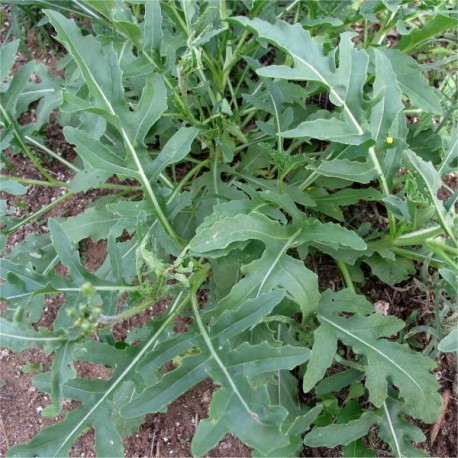
Also known as sylvetta or perennial wall-rocket, wild rocket is the hardier, more flavourful relative of common cultivated rocket. It grows wild along country paths and in uncultivated ground, and today it is highly valued in cooking and fine dining for its bold, slightly bitter, peppery taste, more intense than the cultivated variety.
The wild rocket Plant
Botanically it is Diplotaxis tenuifolia, family Brassicaceae, the same as cabbage, broccoli and mustard, but a different species from cultivated rocket (Eruca vesicaria). It is a perennial herbaceous plant, 20 to 70-80 cm tall, with narrow, elongated and deeply lobed leaves, pale green in colour; the flowers have four lobed yellow petals, gathered in corymb racemes, clearly distinguishable from the whitish-yellow flowers of cultivated rocket.
How to Sow Wild Rocket
Sowing is done broadcast or in shallow rows, during a period ranging from spring to early autumn, avoiding the coldest months. Being perennial, once established the plant can be harvested multiple times over the season through successive cuts, without needing to resow every year.
How to Grow Wild Rocket
It prefers well-drained, nutrient-rich soils, but adapts easily to different environmental conditions, even calcareous and stony ground. It is a very hardy plant, better able than the cultivated type to withstand winter cold: it in fact grows even up to 1000 metres of altitude.
Tips for Growing Wild Rocket
Leaves should preferably be harvested before flowering appears, when they are more tender and less bitter; once in flower, the plant produces increasingly peppery leaves. The yellow flowers are also edible and can be used as a garnish or salad ingredient.
Diseases and Pests of Wild Rocket
Being particularly hardy, wild rocket has few pest and disease issues; the main concerns are flea beetle attacks on young leaves and root rot in cases of prolonged waterlogging.
Properties and Nutritional Values
It is rich in vitamins A, C, E and folic acid, as well as calcium, potassium and iron, with digestive, diuretic and vitamin-boosting properties. Its intense, peppery taste, rich in sulphur compounds such as sulforaphane, makes it ideal raw in salads, pestos and mixed greens, as well as a finishing touch on meats and cheeses.
| Average nutritional values (100 g) | |
|---|---|
| Energy | 25 kcal |
| Protein | 2.6 g |
| Carbohydrates | 2.1 g |
| Fibre | 1.6 g |
| Vitamin C | 15 mg |
| Calcium | 160 mg |